
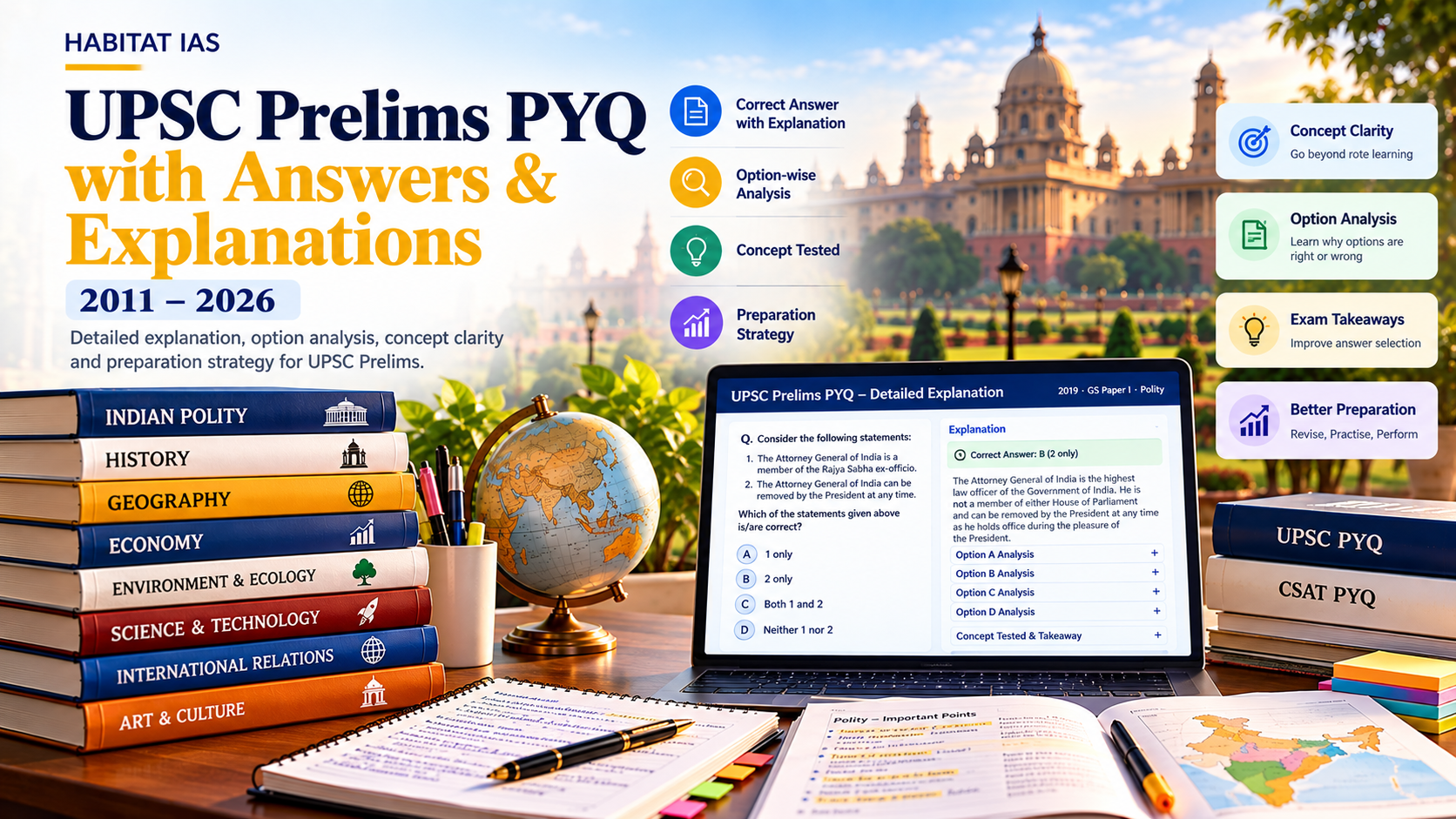
UPSC Prelims PYQ with Answers and Explanations
Previous Year Questions (PYQs) are most valuable when you understand not only which option is correct, but why it is correct. A bare answer key can tell you whether you were right; a good explanation helps you identify the concept, correct a misunderstanding and apply that learning to a new question.
UPSC Prelims questions can test factual knowledge, conceptual distinctions, interpretation of statements and the ability to evaluate options carefully. Analysing a question after attempting it helps reveal which of these skills needs more work.
Habitat IAS's UPSC Prelims Decoded provides a dedicated GS Paper-I PYQ resource with year-wise, subject-wise and topic-wise navigation. Aspirants preparing for Paper II can separately use the UPSC CSAT Topic-Wise PYQ resource.
Do not stop when you discover the right answer. Explain to yourself why it is right, why the alternatives fail and which underlying concept should be revised.
Why Detailed Explanations Matter in UPSC Prelims
1. They expose the actual knowledge gap
A wrong response can come from a forgotten fact, a weak concept, misreading a qualifier or making an unsupported assumption. A useful explanation helps you identify the cause instead of merely marking the question wrong.
2. They help distinguish similar concepts
Many subjects contain terms that appear similar but have different meanings, functions or constitutional and scientific implications. Comparing the options helps you learn the distinction that the question is testing.
3. They make revision more precise
When the explanation identifies the underlying concept, you can return to the relevant syllabus area or standard source. This is more targeted than rereading an entire chapter after every error.
4. They improve reasoning under uncertainty
Not every question will be familiar. Practising careful statement analysis and evidence-based elimination can help you make more disciplined decisions when you cannot recall every fact.
5. They create transferable learning
The purpose is not to memorise a particular question. It is to understand the principle well enough to recognise it when the wording, examples or options change.
What Should a Good UPSC PYQ Explanation Include?
A useful explanation should be specific to the question. It should not repeat the same generic sentence for every option or merely restate the answer key.
Correct answer
State the answer clearly and explain the decisive reason it is correct.
Core concept
Explain the principle, provision, process or factual relationship being tested.
Option-wise analysis
Explain why each option is valid or invalid in the context of the question.
Elimination approach
Show how to reject an option when the available evidence supports doing so.
Concept tested
Connect the question to a specific syllabus area for follow-up revision.
Exam takeaway
Finish with a short, useful lesson that can be applied to future questions.
Every option should be discussed on its own merits. If an option is wrong because of one word, qualification or incorrect relationship, the explanation should identify that specific issue.
How to Analyse a UPSC Previous Year Question
Attempt it before reading the solution
Choose an answer independently. Mark whether your response came from confident knowledge, partial understanding or a guess.
Identify the demand of the question
Notice words such as “only”, “correct”, “incorrect”, “all” and “not”. Determine whether the question asks for a fact, a comparison or an inference.
Check the answer and its reasoning
Read the explanation and identify the exact fact or concept that establishes the answer. Do not rely only on whether your selected option matches.
Review each option separately
Write a short reason for rejecting each incorrect option. If an option is partly correct but fails because of a qualification, record that distinction.
Return to the relevant source
Revise the precise concept from your notes or a reliable reference. Avoid expanding every question into an unnecessarily large set of notes.
Reattempt after an interval
Try the question again later without looking at the answer. Success on a delayed reattempt is a better indicator of learning than immediate recognition.
How to Use Option Elimination in UPSC Prelims
Option elimination is not a shortcut that guarantees a correct answer. It is a way of using what you know to assess which options are defensible and which conflict with established facts or the wording of the question.
Check the precise wording
Absolute words and qualifiers can change the meaning of a statement. Read the full sentence before deciding that it is correct or incorrect; a single word should be evaluated in context rather than treated as an automatic signal.
Separate known facts from assumptions
Ask whether you can support a rejection with a clear reason. An option should not be discarded merely because it sounds unfamiliar or differs from what you expected.
Test the relationship between statements
In statement-based questions, evaluate each statement independently first. Then match the results to the combinations offered by the options.
Know when to stop eliminating
If you cannot support a rejection, acknowledge the uncertainty. Do not turn a weak hunch into a claim of logical elimination.
Practise with the UPSC Prelims PYQ collection
Use the year-wise and topic-wise sections to analyse questions in context.
Explore UPSC Prelims Decoded →Build a PYQ Mistake Log That Actually Helps
A mistake log should be short enough to maintain and specific enough to guide revision. Record why an answer went wrong, not just the question number.
| Field | What to record |
|---|---|
| Question | Year, paper and question reference. |
| Topic | The relevant subject and syllabus concept. |
| Error type | Knowledge gap, misreading, confusion, unsupported guess or time pressure. |
| Correction | The fact or reasoning that resolves the error. |
| Follow-up | The source to revisit and when to reattempt the question. |
Review the log periodically and look for recurring patterns. If several errors come from misreading statements, practise careful question reading; if they arise from the same concept, revise that syllabus area directly.
UPSC Prelims Decoded: PYQs with a Structured Approach
Habitat IAS's UPSC Prelims Decoded is the dedicated destination for exploring the GS Paper-I PYQ collection. The index covers 2011–2026 and provides routes for navigating questions by year, subject and topic.
UPSC CSAT PYQs with Answers and Solutions
CSAT requires a different kind of practice from GS Paper-I. Comprehension, logical reasoning, analytical ability and basic numeracy are best strengthened by solving questions, reviewing the method and practising again.
When reviewing a CSAT solution, focus on the reasoning process as well as the final answer. For numerical questions, identify the method and the steps where errors occur; for comprehension, distinguish what the passage supports from assumptions that go beyond it.
Understand the passage
Check how the answer follows from the passage and why competing interpretations are unsupported.
Make the logic explicit
Identify the relationships, conditions or steps required to reach the conclusion.
Review the method
Record the calculation approach, shortcuts that are valid and the source of any error.
Common Mistakes While Studying Solved PYQs
Reading the solution before attempting
Try the question first so you can identify your actual reasoning gap.
Memorising the answer alone
Learn the concept and the reason the other options do not fit.
Accepting every online explanation without checking
For disputed or factual questions, verify important claims against reliable references and the official answer key where available.
Writing excessively long notes
Keep notes focused on the tested concept, the correction and the takeaway.
Ignoring CSAT practice
Maintain a separate and consistent Paper II practice routine.
Use PYQ Explanations to Improve Your Thinking
A useful PYQ session should leave you with more than a score. It should clarify a concept, expose a gap in your reasoning or strengthen your ability to evaluate options. Attempt first, analyse carefully, revise selectively and return to difficult questions after an interval.
Use UPSC Prelims Decoded for GS Paper-I question navigation and continue with CSAT Topic-Wise PYQs for the separate aptitude paper.
Frequently Asked Questions
Where can I practise UPSC Prelims PYQs with explanations?
Visit UPSC Prelims Decoded on Habitat IAS to navigate the GS Paper-I PYQ collection by year, subject and topic.
Why should I read explanations if I already have the answer key?
An answer key identifies the selected answer, while an explanation helps you understand the concept, assess the options and identify what to revise.
Should every option be explained?
Where possible, reviewing each option is useful because it helps distinguish correct statements from incorrect claims, qualifications or relationships.
How should I use UPSC PYQs for revision?
Attempt questions after studying a topic, analyse errors, revise the relevant concept and reattempt difficult questions after an interval.
Where can I find CSAT topic-wise PYQs?
Use the dedicated UPSC CSAT Topic-Wise PYQ resource on Habitat IAS.
Can previous year questions predict the next UPSC Prelims paper?
No. PYQs help you understand the syllabus and how concepts have been tested, but they cannot guarantee what will appear in a future paper.
Understand the answer. Analyse the options. Retain the concept.
Explore more preparation guides →