
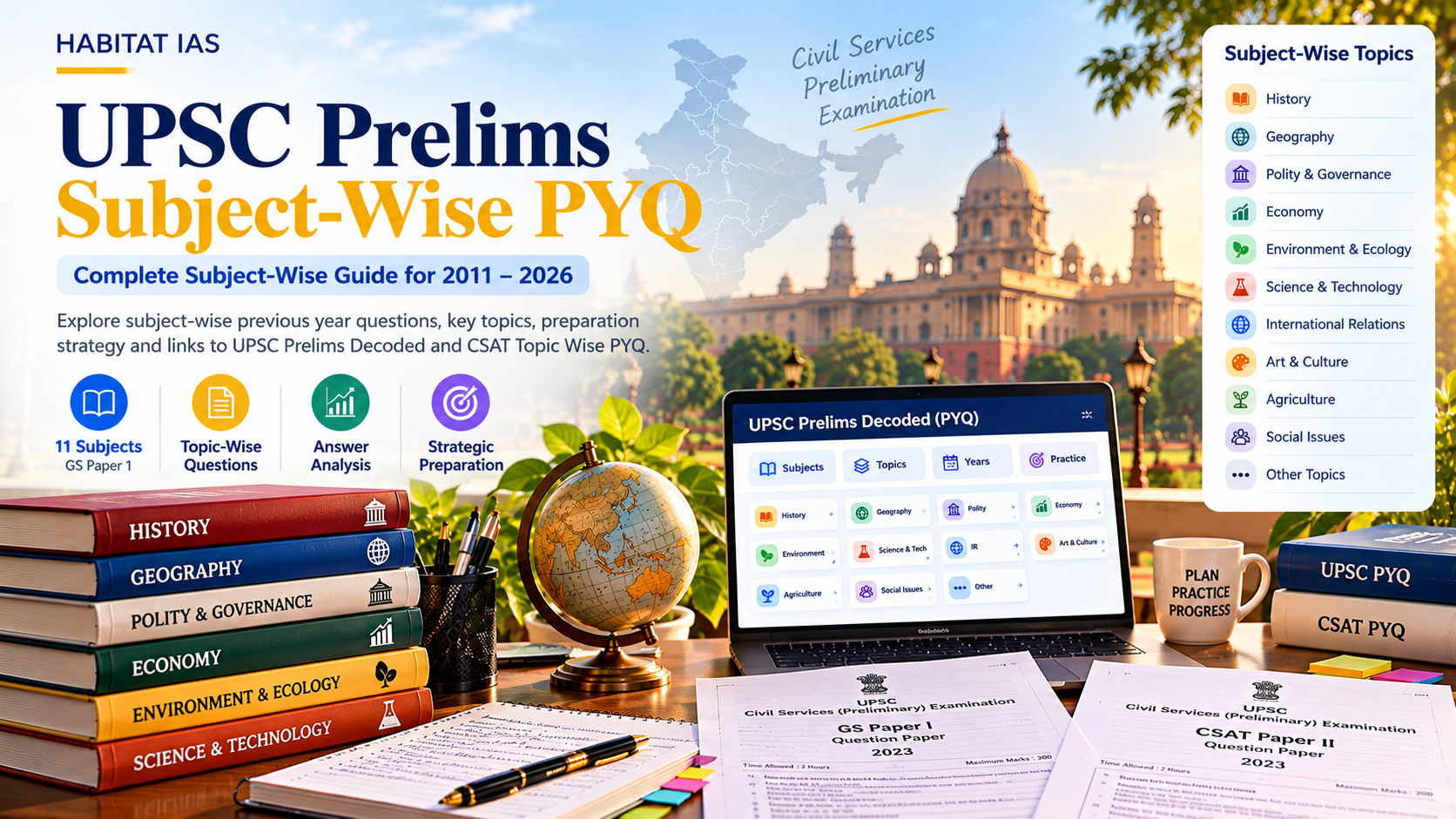
UPSC Prelims Subject-Wise PYQ: Organise Your Practice
UPSC Civil Services Preliminary Examination preparation involves a wide syllabus and multiple kinds of questions. Previous Year Questions (PYQs) help aspirants understand how concepts are tested, where their understanding is incomplete and how to turn syllabus reading into focused practice.
Subject-wise PYQs group questions under broad areas such as History, Geography, Polity, Economy, Environment and Science and Technology. This lets you review questions connected to a subject after studying it, rather than switching randomly between unrelated areas.
Subject-wise practice is not a prediction tool. It is a method for consolidating knowledge, identifying conceptual gaps and building a structured revision routine. After this stage, topic-wise practice can help you narrow your revision further, while year-wise papers help you assess performance across a complete paper.
Habitat IAS provides UPSC Prelims Decoded for GS Paper-I PYQ navigation. Aspirants preparing for the aptitude paper can also use the separate UPSC CSAT Topic-Wise PYQ resource.
Use a subject-wise PYQ set to understand how concepts are examined—not simply to memorise previously correct options.
Why Practise UPSC Prelims PYQs Subject-Wise?
1. Connect reading with examination questions
After studying a chapter or syllabus section, related PYQs help you check whether you can apply the concept in an examination-style question. They can also reveal details that your first reading did not make clear.
2. Identify subject-specific weaknesses
If you repeatedly make mistakes in a particular area, you can distinguish a knowledge gap from a reading error, a confused concept or an unsupported guess. That makes your next revision session more targeted.
3. Revise with a clear structure
Subject-wise collections make it easier to plan revision blocks. You can revisit one subject, review the associated mistakes and then move to another area without losing track of your progress.
4. Compare concepts across different years
Questions from different years may test related ideas in different ways. Comparing them can deepen understanding, but it should not be treated as proof that the same question or topic will repeat.
5. Build a useful mistake log
Record why an answer was wrong, what concept it tested and what you need to revise. Revisit that record periodically rather than relying only on your overall score.
UPSC Prelims PYQs by Subject
The following is a practical subject framework for organising revision. It is not an official UPSC weightage table, and the precise classification of individual questions may vary depending on the concept being tested.
History
Ancient, Medieval and Modern India, freedom struggle, and Art and Culture.
Explore subject resources →Geography
Physical, Indian and World Geography, maps, climate and geomorphology.
Explore subject resources →Polity & Governance
Constitution, Parliament, Judiciary, constitutional bodies and governance.
Explore subject resources →Economy
Banking, inflation, growth, fiscal policy, budget and economic development.
Explore subject resources →Environment & Ecology
Ecosystems, biodiversity, climate change, conservation and conventions.
Explore subject resources →Science & Technology
Space, biotechnology, health-related developments and emerging technologies.
Explore subject resources →International Relations
International organisations, bilateral relations and global developments.
Explore subject resources →Art & Culture
Architecture, sculpture, literature, heritage and cultural traditions.
Explore subject resources →Agriculture
Crops, agricultural practices, food security and related policies.
Explore subject resources →Social Issues
Education, health, population, welfare and human development themes.
Explore subject resources →Other Topics
Additional syllabus-linked areas and miscellaneous question themes.
Explore subject resources →Open the UPSC Prelims Decoded index and continue through the available subject and topic navigation.
How to Use Subject-Wise PYQs Effectively
Read the relevant syllabus section
Identify the subject and the specific syllabus area you are studying. Use the syllabus to guide your work instead of attempting questions without a plan.
Study the core concepts
Use your chosen standard source and notes to build a basic understanding before attempting the associated PYQs.
Attempt questions before checking answers
Try each question independently. Mark whether your answer was confident, uncertain or a guess so you can interpret your result properly.
Analyse every option
Understand why the correct option is valid and why the alternatives are incorrect. Review the underlying concept rather than memorising the answer letter.
Revise and retest
Make a concise note of mistakes and revisit difficult questions after an interval. Later, use full year-wise papers to test how well you can apply concepts across subjects.
How to Analyse a Subject-Wise PYQ
A question review should answer four things: what concept was tested, why the correct answer is correct, why your chosen option was wrong if you made an error, and what you should revise next.
Concept tested
Write down the core principle, provision, process or factual relationship.
Option analysis
Identify the exact reason each relevant alternative is right or wrong.
Error category
Classify the mistake as a knowledge gap, misreading, confusion or guess.
Revision action
Specify the source or note to revisit and when to retest yourself.
A correct answer reached by guessing is still worth reviewing. Understanding why it is correct makes the learning more reliable than a score alone.
Explore UPSC Prelims Decoded
To move from this general guide to actual question practice, visit UPSC Prelims Decoded (PYQ). The resource is designed around GS Paper-I previous year questions from 2011–2026, with year-wise, subject-wise and topic-wise navigation.
Use the subject index to locate a broad area, then continue to topic-level practice where available. This is useful for turning a revision plan into a focused question-solving routine. Always confirm the question's context and explanation rather than treating subject labels as a substitute for conceptual analysis.
Do Not Ignore UPSC CSAT Topic-Wise PYQs
CSAT is a separate paper in the Civil Services Preliminary Examination and requires its own preparation plan. Its questions assess aptitude areas such as reading comprehension, logical reasoning, analytical ability and basic numeracy. GS Paper-I subject-wise practice cannot replace CSAT-specific question solving.
Topic-wise CSAT practice can help you discover whether you need more work on comprehension, reasoning, numerical methods or time management. Practise consistently, review mistakes and check your performance against the current official examination requirements.
Read carefully
Practise interpreting passages and selecting conclusions supported by the given text.
Use a structured method
Work through logical relationships and analytical questions step by step.
Build accuracy
Practise relevant arithmetic and numerical problem-solving with attention to time.
Common Mistakes in Subject-Wise PYQ Practice
Memorising options without understanding
Recognising a familiar answer does not prove that you understand the concept behind it.
Skipping incorrect options
Reviewing why alternatives are wrong can reveal important distinctions and misconceptions.
Assuming that past frequency predicts the next paper
Past questions are a learning resource, not a guarantee of future topic weightage.
Practising only one subject
Focused subject practice should eventually be complemented by mixed and full-paper practice.
Leaving CSAT until the end
Give CSAT its own regular practice schedule and review progress separately.
Turn Subject-Wise PYQs into a Revision System
Subject-wise PYQs are most useful when they are part of a repeatable cycle: study a syllabus area, attempt related questions, analyse every option, record mistakes and revise the underlying concept. Use topic-wise practice to sharpen your understanding and year-wise papers to assess performance across a complete examination.
Visit UPSC Prelims Decoded for GS Paper-I question navigation, and use UPSC CSAT Topic-Wise PYQ for the separate aptitude paper.
Frequently Asked Questions
What are UPSC Prelims subject-wise PYQs?
They are previous year questions organised under broad subjects such as History, Geography, Polity, Economy, Environment and Science and Technology to support focused practice.
Where can I find subject-wise UPSC Prelims PYQs?
Visit UPSC Prelims Decoded on Habitat IAS and use the available subject and topic navigation.
What is the difference between subject-wise and topic-wise PYQs?
Subject-wise collections group questions under a broad subject; topic-wise collections narrow them to specific concepts within that subject.
Should I solve subject-wise PYQs before full papers?
After studying a subject, related PYQs can help consolidate concepts. Full year-wise papers are also important for assessing performance across a complete paper.
Where can I practise UPSC CSAT topic-wise PYQs?
Use the separate UPSC CSAT Topic-Wise PYQ resource on Habitat IAS.
Can previous year questions predict the next UPSC Prelims paper?
No. PYQs help you understand how concepts have been tested, but they cannot guarantee future questions or topic weightage.
Understand the subject. Analyse the question. Revise with purpose.
Explore more preparation guides →