
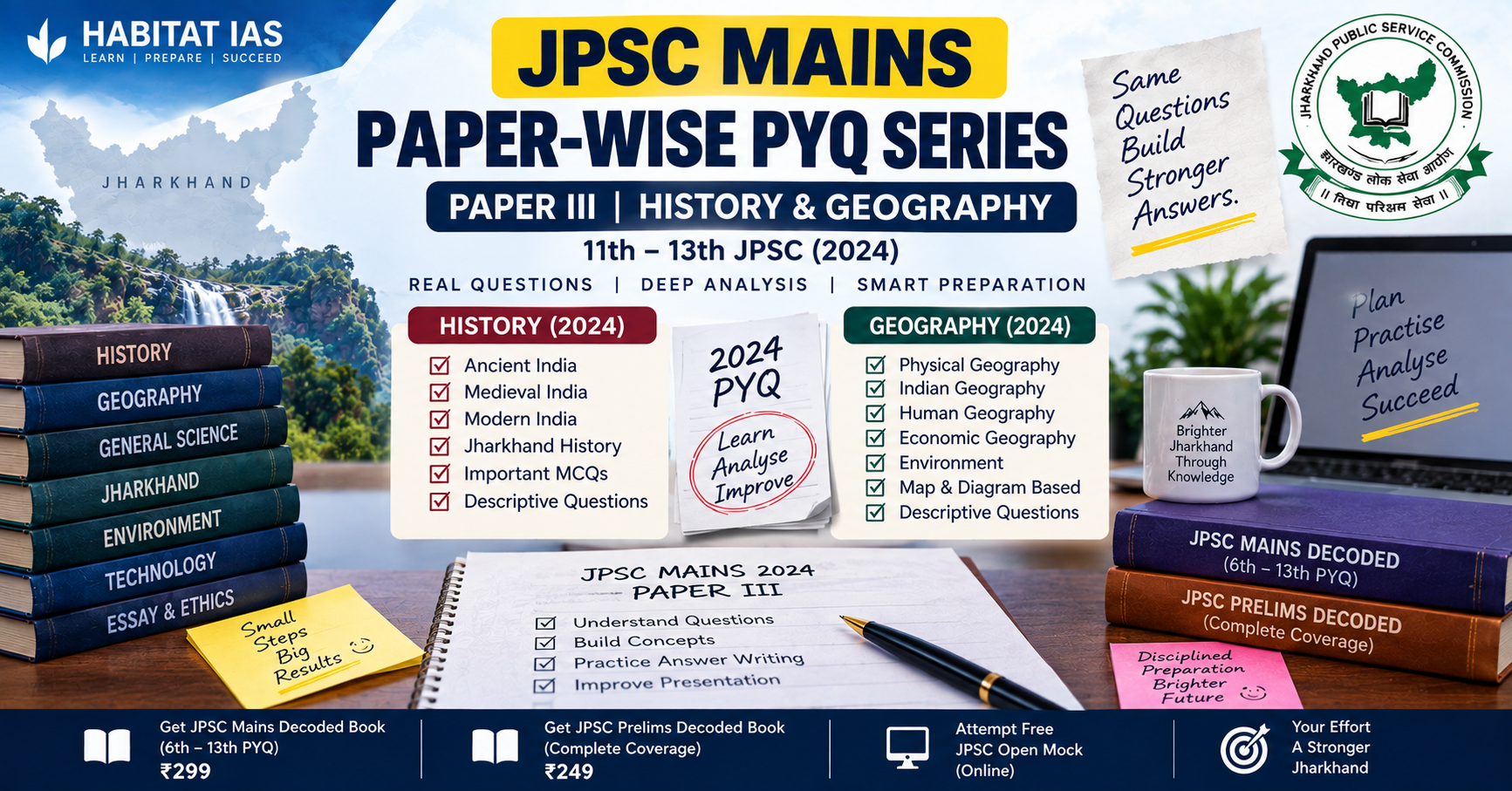
The 7th–10th JPSC Mains Previous Year Questionsare particularly useful for understanding how JPSC combines objective knowledge with descriptive answer writing.
The Paper III material used for this analysis containsHistory and Geography, with both objective and descriptive components. Instead of treating the paper as a list of answers, aspirants can use it to identify the concepts and syllabus areas behind each question.
1. 7th–10th JPSC Mains 2022: What Does the PYQ Show?
The 7th–10th JPSC Mains Paper III material contains separate History and Geography sections.
This structure makes Paper III important for both factual revision and descriptive answer-writing preparation.
2. JPSC Mains Paper III: History & Geography
A strong preparation strategy should study Paper III in two dimensions:
Knowledge & Recall
Important facts, concepts, locations, personalities, institutions and historical developments.
Explanation & Analysis
Causes, consequences, relationships, comparisons and structured explanations.
3. 7th–10th JPSC Mains History PYQ
The History objective questions demonstrate that JPSC can move across Ancient India, Medieval India, Modern India and Jharkhand-related history within the same paper.
The famous Dancing Girl and the material from which it was made.
Local self-government as a striking feature of Chola administration.
The military department known as Diwan-i-Arz.
His real name, Farid.
His association with Majma-ul-Bahrain.
His first journey from Durban towards Pretoria.
The famous "Chalo Delhi" call.
The reason connected with his release from prison in 1897.
These examples are taken from the 7th–10th JPSC Mains Paper III question material.
What does the History PYQ pattern tell you?
4. 7th–10th JPSC Mains Geography PYQ
Geography should not be studied only through map-based factual revision. The consolidated PYQ analysis in the Mains material shows descriptive questions across physical geography, biogeography, economic geography and Indian geography.
The broader 6th–13th JPSC analysis in the book separately identifies Physical Geography, Jharkhand Geography, Indian Geography, Human Geography, Biogeography, Economic Geography, Environment and Energy Geography as topic areas.
5. Do Not Memorise the PYQ — Convert It Into a Topic
One of the biggest mistakes in JPSC Mains preparation is memorising only the answer to a previous year question.
Instead, use this method:
Identify exactly what JPSC asked.
Identify the syllabus topic behind it.
Study related concepts and facts.
Revisit the PYQ after studying.
Example: Chola Administration
6. Jharkhand-Specific History in the 7th–10th JPSC PYQ
Jharkhand-specific preparation is one of the areas that should receive dedicated attention in JPSC preparation.
The 7th–10th JPSC History PYQ includes a question concerningBirsa Munda and his release from prison on 30 November 1897 before the expiry of his sentence.
7. Use JPSC Mains PYQs for Answer Writing
Descriptive PYQs should become your answer-writing practice material.
A PYQ is therefore not only a revision resource. It is also a ready-made source of answer-writing practice.
8. How to Prepare JPSC Mains With PYQs
Establish the boundaries of Paper III.
Identify the areas JPSC has actually tested.
Expand each question into a complete topic.
Practise descriptive questions under time limits.
Study JPSC Mains PYQs Topic-Wise
JPSC Mains Decoded: Topic-Wise PYQs organises Mains previous year questions into a structured preparation resource with topic-wise coverage and answer-focused analysis.
Continue Your PYQ Preparation for Prelims
Use topic-wise and subject-wise Prelims PYQs for factual revision, explanations and exam-focused preparation.
Study the PYQs. Now Test Yourself.
Attempt a free JPSC Open Mock after your PYQ revision and check your preparation under test conditions.
9. Key Takeaways From the 7th–10th JPSC Mains PYQ
Frequently Asked Questions
What is the 7th–10th JPSC Mains PYQ?
The 7th–10th JPSC Mains PYQ refers to the previous year questions from the 7th–10th JPSC Civil Services Mains examination cycle. The Paper III material covers History and Geography through objective and descriptive questions.
What does JPSC Mains Paper III cover in the 7th–10th examination?
The Paper III material used here covers History and Geography. The History section includes objective and descriptive questions, while Geography also contains objective and descriptive questions.
Which History topics were asked in 7th–10th JPSC Mains?
The question material includes Ancient India, Medieval India, Modern India and Jharkhand history themes, including Mohenjo-daro, Chola administration, Delhi Sultanate, Sher Shah Suri, Dara Shikoh, Gandhi, Subhas Chandra Bose and Birsa Munda.
Should I prepare only the exact questions asked in JPSC Mains?
No. A PYQ should be used to identify the larger topic behind the question. Study the underlying concept and related subtopics rather than memorising only the answer.
Is JPSC Mains PYQ useful for answer writing?
Yes. Descriptive PYQs can be converted into answer-writing practice by identifying the demand of the question, preparing an introduction, structured arguments, examples and a conclusion.
Where can I practise after studying JPSC Mains PYQs?
Habitat IAS provides a free JPSC Open Mock that can be used for additional practice after PYQ-based preparation.