
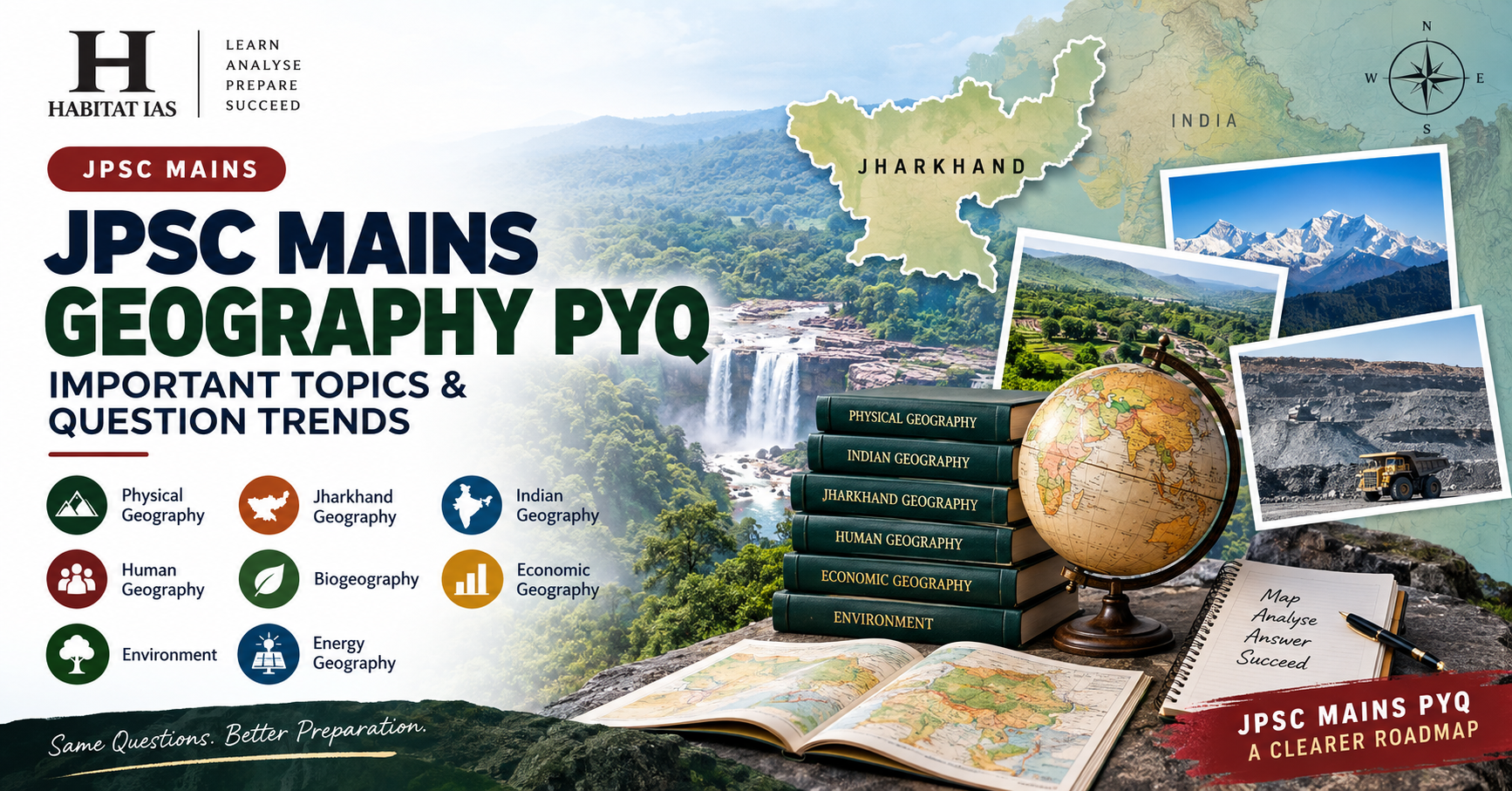
JPSC Mains Geography questions are spread acrossPhysical Geography, Jharkhand Geography, Indian Geography, Human Geography, Biogeography, Economic Geography, Environment and Energy Geography.
Among these, Physical Geography and Jharkhand Geography form particularly large clusters in the analysed 6th–13th JPSC Paper III material.
Geography is one of the subjects whereJPSC Mains PYQ analysiscan significantly improve preparation efficiency.
Instead of treating every chapter as equally important, previous year questions allow an aspirant to understand the areas that JPSC has actually tested.
More importantly, JPSC does not necessarily repeat the exact same question. A familiar topic can be tested through a different geographical process, region, resource or analytical angle.
This article therefore looks at the Geography PYQs through their broader topic structure and question trends.
Table of Contents
- JPSC Mains Geography PYQ Topic Map
- Physical Geography PYQ
- Jharkhand Geography PYQ
- Indian Geography PYQ
- Human Geography PYQ
- Biogeography PYQ
- Economic Geography PYQ
- Environment & Energy Geography
- Geography Answer Writing
- JPSC Mains Geography Preparation Strategy
- PYQ-Based Study Resources
- Frequently Asked Questions
JPSC Mains Geography PYQ Topic Map
The 6th–13th JPSC Paper III analysis divides Geography into eight major categories.
1. Physical Geography — JPSC Mains Geography PYQ
Physical Geography is the largest Geography category identified in the 6th–13th JPSC Paper III analysis.
The descriptive questions demonstrate that JPSC can move from fundamental Earth processes to atmospheric systems and climatology.
Discuss how seismology throws light on the constitution of the interior of the earth.
Describe the weather of a tropical cyclone. Where do these storms originate? What path do they usually follow?
Differentiate between tropical and temperate cyclones.
These questions cover different parts of Physical Geography but share a common requirement:explain geographical processes rather than simply memorise definitions.
Physical Geography areas to prepare
Seismic waves, Earth's internal structure and evidence used to understand the interior.
Landforms, erosion and major geomorphological processes.
Cyclones, atmospheric processes and climatic systems.
Solar-system concepts and Earth-related geographical processes appearing in the PYQs.
2. Jharkhand Geography — A Major JPSC Focus Area
Jharkhand Geography is particularly important for JPSC because questions can connect the state's physical geography with resources, settlements, agriculture, environment and human activity.
The descriptive-question trend is especially useful.
The supplied PYQ analysis identifies this progression as:settlement pattern → resource distribution → environmental consequences.
Explain the rural settlement types in Jharkhand.
Discuss in detail the occurrence & distribution of coal in Jharkhand.
Identify the regions affected by land degradation and soil erosion in Jharkhand. Discuss the major causes of erosion in the State.
Jharkhand Geography topics to prepare
- Physiographic regions of Jharkhand
- Rivers and waterfalls
- Soils
- Coal and mineral resources
- Power projects
- Tribal geography
- Rural settlements
- Irrigation
- Land degradation and soil erosion
- Forests and environmental geography
Examples from JPSC Geography MCQs
The highest waterfall in Jharkhand is:
Answer:Burhaghagh
Where is black soil found in Jharkhand?
Answer:Rajmahal hill region
Tenughat Power Project is concerned with:
Answer:Thermal Power
Sadni Waterfalls in Jharkhand is on which river?
Answer:Sank River
Jharkhand is the largest producer of which variety of silk in India?
Answer:Tasar
These objective questions show why Jharkhand Geography preparation should include bothconceptual regional geographyandfactual state-specific revision.
3. Indian Geography — JPSC Mains PYQ
Indian Geography is another substantial category in the analysed Paper III material.
Preparation should connect India's physical environment with vegetation, mineral resources, agriculture and regional characteristics.
Tropical rainforest in India is found in which regions?
Answer:Assam and Kerala
In which mineral does India have the largest deposit in the world?
Answer:Kyanite
Indian Geography preparation areas
Types, distribution and relationship with rainfall and climate.
Distribution, resource regions and geographical significance.
Cropping patterns, regional conditions and agricultural geography.
Relief, climate, rivers, soils and their relationship with human activities.
4. Human Geography — Population, Tribes & Urbanisation
Human Geography appears through themes involving population, tribes, settlements, urbanisation and human-environment relationships.
Account for the rapid urbanisation of India after independence.
Which census year is known as the "Big Divide" or "Demographic Divide" in India?
Answer:1921
The Toda tribes mostly reside in which state?
Answer:Tamil Nadu
Questions on shifting cultivation can test the geographical names used in different parts of Asia.
The key preparation principle is to connectpopulation + settlement + migration + urbanisation + regional geography.
5. Biogeography — A Small but Important Cluster
Although Biogeography has a smaller identified question count, its descriptive questions demonstrate a clear relationship between climate and vegetation.
Describe the relationship between the annual rainfall in India and its natural vegetation.
Discuss the characteristics and spatial distribution of different types of vegetation in India.
The source analysis highlights a broad relationship: lower rainfall is associated with thorn and scrub vegetation, while increasing rainfall supports progressively denser vegetation types, with evergreen forests associated with high rainfall conditions.
6. Economic Geography — Industries & Location Factors
Economic Geography questions require an understanding of why economic activities are located in particular regions.
In recent time sugar industry in India is shifting from North to South, explain.
Critically evaluate the favourable factors to establishment and development of Iron and Steel Industry in India.
The supplied analysis explains the sugar-industry question through factors such as agro-climatic conditions, sugarcane cultivation, sucrose recovery, crushing season, cooperative structures and irrigation.
Economic Geography framework
Where are the required resources located?
What labour conditions influence the industry?
How does market access affect location?
How does infrastructure influence location?
7. Environment & Energy Geography
Environment and Energy Geography form smaller categories in the identified Geography classification, but the questions can require substantial conceptual preparation.
Examine the potential and challenges of solar energy in India. How may Government intervention help towards adoption and expansion of solar energy as a major energy source?
Which among the following was declared the second Biosphere Reserve of India on 18-01-1988?
Answer:Nanda Devi
For these areas, prepare the basic concept first and then connect it with Indian examples, resources, environmental consequences and policy dimensions where the question demands it.
JPSC Geography: Do Not Separate Facts from Concepts
Geography PYQs demonstrate that objective and descriptive preparation should support each other.
River, resource, region, tribe or geographical feature.
Understand why the geographical phenomenon occurs.
Apply the concept to India or Jharkhand.
Explain causes, effects, differences and solutions.
JPSC Mains Geography Answer-Writing Strategy
Geography answers become stronger when they combinegeographical terminology, structure, examples and spatial reasoning.
Use the wording of the question
Cover the important dimensions of the issue.
Establish the process and causal relationship.
Compare the two geographical phenomena using appropriate parameters.
Present favourable factors as well as limitations or counter-arguments.
Establish the region or phenomenon before explaining its geographical significance.
Simple Geography answer structure
- Introduction:define or introduce the geographical issue.
- Spatial context:mention the relevant region, distribution or location.
- Main explanation:organise causes, processes or characteristics under clear headings.
- Examples:add India/Jharkhand-specific examples wherever relevant.
- Impacts:explain environmental, economic or social consequences when required.
- Conclusion:finish with a concise geographical assessment or forward-looking point.
How to Prepare JPSC Mains Geography Using PYQs
Step 1 — Divide Geography into major clusters
Start with the eight categories identified in the PYQ analysis:
- Physical Geography
- Jharkhand Geography
- Indian Geography
- Human Geography
- Biogeography
- Economic Geography
- Environment
- Energy Geography
Step 2 — Build topic-wise PYQ notes
Do not keep all questions under 2019, 2022 and 2024 separately. Bring questions on the same topic together.
Step 3 — Identify changing question angles
Jharkhand Geography provides a useful example: settlement → resources → environmental consequences.
Step 4 — Prepare diagrams where useful
Geography answers can benefit from simple diagrams, flowcharts, maps and process representations when they genuinely clarify the answer.
Step 5 — Combine Indian and Jharkhand examples
For JPSC, maintain a separate bank of examples from Jharkhand while also preparing broader Indian Geography.
Step 6 — Practise descriptive PYQs under time limits
Reading a PYQ is not the same as answering it. Write timed answers and check whether the response actually addresses the command word.
Study JPSC Mains Geography PYQs topic-wise
JPSC Mains Decoded: Topic-Wise PYQshelps organise previous year questions around subjects and topics instead of leaving them scattered across different papers.
- Topic-wise PYQ organisation
- Mains-focused preparation
- Previous year question analysis
- Systematic topic coverage
- Revision-oriented resource
- Digital PDF
Continue PYQ preparation for JPSC Prelims
Use topic-wise previous year questions to strengthen your Prelims revision alongside Mains preparation.
JPSC Prelims Decoded: Topic-Wise PYQsprovides structured topic-wise and subject-wise PYQ preparation.
- Topic-wise PYQs
- Subject-wise organisation
- Detailed explanations
- Trend-oriented revision
- Jharkhand-specific coverage
Test your JPSC preparation
After revising Geography PYQs, test your broader General Studies preparation with the free JPSC GS mock.
Take Free JPSC GS Mock →JPSC Mains Geography PYQ: Quick Revision Checklist
Related JPSC Mains PYQ Articles
Frequently Asked Questions
Which Geography topics are important for JPSC Mains?
The analysed JPSC Mains Paper III material covers Physical Geography, Jharkhand Geography, Indian Geography, Human Geography, Biogeography, Economic Geography, Environment and Energy Geography.
Is Jharkhand Geography important for JPSC Mains?
Yes. Jharkhand Geography is a major recurring category and includes settlements, coal resources, land degradation, soil erosion, rivers, waterfalls, tribes, irrigation and power projects.
Which Physical Geography topics should I prepare?
The analysed descriptive questions include Earth interior and seismology, tropical cyclones and the distinction between tropical and temperate cyclones. Broader Physical Geography preparation should cover the relevant syllabus as well.
How should I prepare Geography for JPSC Mains?
Divide Geography into major topic clusters, classify PYQs topic-wise, identify changing question angles, prepare conceptual notes, use Indian and Jharkhand examples and practise descriptive answers.
Can Geography PYQs help with answer writing?
Yes. Descriptive PYQs can be used directly as answer-writing practice. Focus on the question's command word, spatial context, geographical terminology, examples and logical structure.
Prepare Geography from the questions JPSC has actually asked.
Use PYQs to identify patterns, build topic-wise notes, revise intelligently and practise analytical answers.